
San Juan County Court Records After Arrest
After a San Juan County arrest, the jail record and the court record are separate. The custody record may show whether the person is held through the La Plata County Detention Facility and VINELink. The court record shows what charges were filed, what hearings are scheduled, what bond conditions apply, and how the case is moving. A booking entry can come before prosecutor review, so it should not be treated as the final charge record.
San Juan County is part of Colorado's 6th Judicial District. The official Colorado Judicial Branch San Juan County page lists the courthouse, dockets, court streams, records links, and court hours. The criminal case is handled through the court, while prosecution context comes from the 6th Judicial District Attorney, which serves Archuleta, La Plata, and San Juan Counties.
Booking and custody details belong with San Juan County jail inmate records. Booking photos, if a photo exists or can be requested, belong with the San Juan County jail mugshots process. Court records after a jail arrest should be read as filed case records, not as proof that every arrest allegation became a conviction.
Find Court Records After Arrest
The San Juan County Judicial Branch page is the first official court source. It links to docket search and records request options. The court record request page lists SanJuanClerk@judicial.state.co.us and a webform for record or document requests. The courthouse address is 1557 Greene Street, P.O. Box 900, Silverton, CO 81433. Court hours are limited, with Monday afternoon hours, Tuesday and Thursday business hours with a midday closure, and Wednesday and Friday closed.
- Start with the San Juan County Judicial Branch page and use the docket search for scheduled hearings.
- Search or request by defendant name, case number, county, and approximate arrest or filing date.
- Read the charge list as the prosecutor-filed record, not merely the jail booking allegation.
- Check each charge for status, hearing dates, bond conditions, and disposition if the case is resolved.
The official court records request page is a strong source when a docket entry does not provide enough detail.
Source: San Juan County court record request form
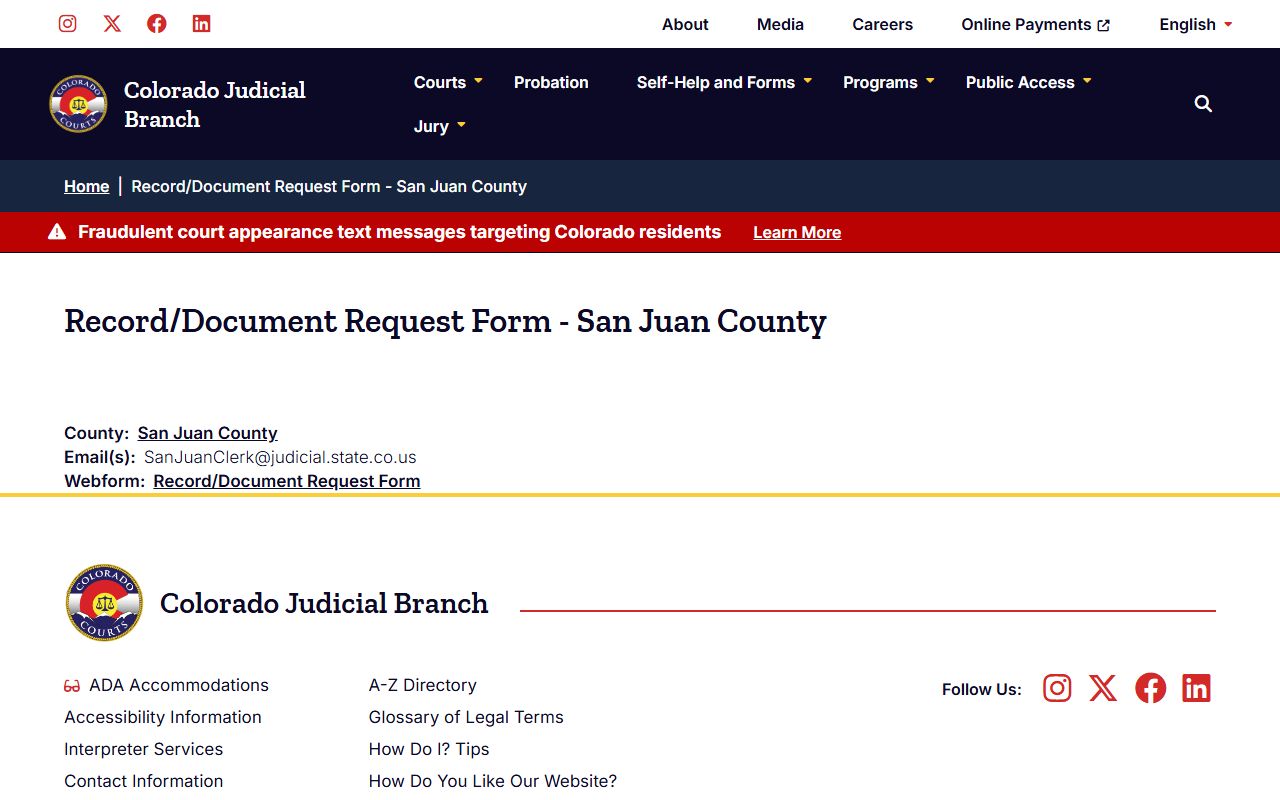
The request route is useful when a party needs copies of complaints, orders, bond paperwork, or docket documents from the clerk.
San Juan County Court Search Fields
The research did not capture a full static case-search form, but it did identify the fields commonly needed for a court records after arrest request in San Juan County. Better search terms help the clerk or docket tool separate a criminal case from a traffic, civil, probate, or domestic case.
| Field | Use | Notes |
|---|---|---|
| Defendant name | Main name search | Use full legal name if known; spelling differences can affect results. |
| Case number | Exact case match | Best field when it appears on a summons, docket, or court notice. |
| Court location | County filter | Use San Juan County, 6th Judicial District. |
| Approximate date | Search narrowing | Use arrest date, filing date, or hearing date when known. |
| Charge or citation detail | Request context | Helpful when the jail or officer paperwork lists a charge or citation. |
| Requester contact | Clerk response | The webform and email request route need contact information for follow-up. |
Charges Filed After Arrest
A San Juan County arrest may begin with officer-listed allegations or a warrant. The prosecutor decides what formal charges to file. La Plata County's District Attorney court-information page explains Colorado's basic court split: county court handles misdemeanor criminal cases, and district court handles felony criminal cases, along with juvenile and other case types. That structure applies in the 6th Judicial District context for San Juan County cases.
| Document | Who Files It | Common Use | What It Starts |
|---|---|---|---|
| Complaint | Officer or prosecutor | Often used to begin misdemeanor or initial criminal matters. | The court case and charge record. |
| Information | Prosecutor | Common formal charging paper for many felony cases. | The filed criminal case without a grand jury indictment. |
| Indictment | Grand jury | Used in serious or grand-jury-reviewed matters. | A case based on grand jury charges. |
The La Plata County court-information page is useful for this district-level court structure, while the Colorado District Attorneys' Council listing confirms the 6th Judicial District Attorney serves San Juan County.
San Juan County Charge Status
Charges can change after a jail arrest. A prosecutor can file a different charge than the arresting officer listed, amend a charge, add a count, dismiss a count, or resolve a charge through a plea or verdict. A court records after arrest search should check status for each count rather than reading the first docket entry as the final case outcome.
| Status | What It Means |
|---|---|
| Pending | The charge has not reached a final court outcome. |
| Amended | The prosecutor or court changed the charge, level, or wording. |
| Reduced | The charge level or offense was lowered, often through plea or review. |
| Dismissed | The count was dropped by court action or prosecutor request. |
| Disposition | The current or final outcome, such as plea, verdict, dismissal, or sentence. |
Note: A docket can show hearings, filings, and dismissed counts without showing a conviction.
Bond After Jail Arrest
Bond after a San Juan County arrest can involve both the court and the contracted jail. The court sets bond amount and release conditions. La Plata jail staff process jail custody and payment routes when the detainee is held there. La Plata's bond page lists TouchPay online, the jail lobby kiosk, bondsmen, and exact cash. The online or kiosk route requires the Offender ID from VINELink More Info.
| Bond Type | How It Works |
|---|---|
| Cash bond | Payment of cash as ordered by the court; La Plata says cash must be exact because the jail cannot make change. |
| Surety bond | A licensed bondsman posts bond, usually for a fee and contract terms. |
| Personal recognizance | Release based on a promise to appear and court conditions rather than full cash payment. |
| No-bond hold | A court or agency hold blocks release by payment alone. |
| Other-agency hold | A warrant, parole, federal, DOC, or ICE matter may keep the person in custody after local bond is addressed. |
Warrants and Arrest Cases
No official San Juan County active warrant search was located in the research. Warrant questions should use direct channels: the San Juan County Sheriff's Office, the San Juan County open-records page, the San Juan docket search, and the court clerk. A bench warrant can be tied to a court case and may not appear on a sheriff webpage. If the person is already jailed, the custody side still goes through La Plata/VINELink.
Federal warrants and federal custody are outside ordinary county records. Use the U.S. Marshals Service District of Colorado or BOP locator when the case has moved into the federal system. A federal hold can change custody status even if a local San Juan court charge is pending or resolved.
Charges Versus Convictions
Being arrested, booked, or charged is not the same as being convicted. Court records after a jail arrest may show accusations, bond terms, hearing dates, filings, and later outcomes. A conviction requires a plea, verdict, or other final disposition that supports that result. This distinction is central when comparing a roster entry to a court case.
| Point | Charge | Conviction |
|---|---|---|
| Stage | An accusation filed or listed in the case. | A final outcome through plea, verdict, or qualifying disposition. |
| Proof level | Can begin with probable cause or prosecutor review. | Requires legal proof or admission sufficient for conviction. |
| Can change | May be amended, reduced, added, or dismissed. | Changes only through court action, appeal, or post-conviction process. |
| Reader caution | Do not treat it as guilt. | Verify the exact count and final disposition. |
Sealed Versus Expunged Records
Colorado criminal records can be limited by sealing, expungement, juvenile confidentiality, suppression orders, or case-specific restrictions. Sealing usually limits public access to a record while leaving limited official access. Expungement is more associated with records-clearing treatment that can remove or treat a record as though it did not exist in specific contexts. Eligibility depends on the case type, outcome, waiting periods, and court order.
| Point | Sealed | Expunged |
|---|---|---|
| Public visibility | Hidden or restricted from routine public access. | Removed or treated as cleared in eligible contexts. |
| Official access | Some justice agencies may retain limited access. | Access is narrower and depends on the controlling law. |
| Common trigger | Eligible dismissal, acquittal, completed sentence, or statutory path. | Often tied to specific juvenile or statutory eligibility rules. |
| Action needed | Usually requires a court process or order. | Usually requires a court process or statute-based process. |
Colorado Records Law
Court records, sheriff records, and jail records do not all use the same access rule. Colorado's open-records law, C.R.S. 24-72-201 to 206, governs many public records. The CORA timing summary explains the general three-working-day response period with possible extension for extenuating circumstances. Criminal justice records use Colorado's Criminal Justice Records Act, C.R.S. 24-72-301 et seq.
San Juan County's open-records page says criminal-justice records route through the Sheriff's Office dispatcher and instructs requesters to use Records Request in the header. Court records should go to the court clerk and Judicial Branch request form instead. Standard photocopies are capped at the CORA limit unless actual costs exceed it.
Important: Court, custody, and records data may be incomplete or delayed, so verify the current status with the clerk or record custodian.
Restricted Court Records After Arrest
Some court records after a San Juan County arrest may be unavailable to the general public. Juvenile matters, sealed cases, suppressed documents, protected victim information, medical or treatment material, and active investigative records can be restricted. A clerk may confirm that a record exists while refusing a document, or may require a narrower request before release.
When a docket exists but a document is unavailable, the next step is a precise records request through the court clerk. Include the case number if known, the defendant name, the record sought, and a direct contact method. For sheriff-generated arrest reports or criminal reports, use the San Juan open-records process rather than the court clerk.